

// Emergence: Toward Autonomous Structure Discovery in Adapt-1
Read the Discovery documentation · View the experiment guide · Discovery is live in the Adapt-1 API
Before reading: Part 1 · Adaptive State from Partially Observed Streams · Part 2 · Introducing Adapt-1 Preview · Part 3 · Behavioral Report.
Today we are releasing Discovery (Beta) for Adapt-1. It is available inside the ongoing Adapt-1 Preview. Discovery is what happens when the authored learner ontology is removed and the substrate has to build its own model of interaction.
Adapt-1 Preview already moved task learning into operation. An instance could begin with empty learned state and no fitted task model, then update from ordered experience. The Domain could still choose the learner-facing interpretation of that experience before the first event: policy identities, observation fields, transition inputs, temporal windows, causal variables, and action-to-state bindings. 1
With Discovery enabled, those choices can begin unresolved. Interaction enters the learner, Discovery determines which variables and bindings matter, and the resulting transition and causal structure becomes persistent state. The next query can use that structure to estimate how the world changes when Adapt-1 acts.
The task contract is simple. It describes the interaction surface, legal choices, learnable outcome, chronology, and episode boundary. Adapt-1 Preview and Adapt-1 Preview (Discovery Enabled) use the same Core and learning routes. Discovery changes what must be authored before the run.

1. The learner view
Most online systems can update estimates during operation while the feature view stays fixed. Fields, record boundaries, temporal context, and variable roles are selected before learning begins.
Adapt-1 Preview (Discovery Enabled) makes that learner-facing ontology part of the running state. The notation below formalizes observable API behavior. It leaves the private path-ranking, utility-estimation, and commit algorithms unspecified.

Let denote the task contract declared through the Domain API, the learner view active at step , the task state learned through that view, and a completed event. The public transition is
contains the active paths, representations, temporal contexts, action and intervention roles, causal bindings, lifecycle status, and revision identity. contains the task state accumulated through that view.
View readiness and task competence mature separately. A projection can become executable before enough compatible task evidence exists to support a prediction.
Beta exposes two complementary surfaces. Transition projection forms stable scalar inputs and before-and-after bindings. Structural representation discovery evaluates current fields, bounded field combinations, and within-episode lags. Both commit inspectable state.
2. Commit and rebuild
Automatic transition projection starts with a target and an empty input list. Completed events can be retained while learner admission remains closed. The projection reports accumulating, and a successful event write can still report projection_accumulating.
Core commits a new view revision after the retained events support a stable and sufficiently available scalar projection. Projection admission establishes an executable record contract. Predictive usefulness is learned after admission.
Here, is the bounded retained event buffer and means “read this event through the committed view.” Earlier compatible events are rebuilt through the new revision.
The commit can make several retained events eligible at once. The sample count can remain at zero while the view accumulates, then advance by more than one on the event that makes the projection ready.
| Stage | Learner-view state | Learner admission |
|---|---|---|
| Opening events | accumulating, no executable paths | events stored, samples withheld |
| Supported commit | ready, schema_changed: true, revision advances | compatible buffered events rebuilt |
| Following query | discovered paths define required context | prediction or typed abstention |

The lifecycle remains online. Interaction supplies evidence for the learner view, the committed view becomes persistent state, and retained interaction is immediately reconsidered through it. View formation and task learning share one attributed history.
3. Representation evidence
Transition projection decides which scalar paths can form an executable record. Structural representation discovery evaluates a broader bounded family:
The first term contains current fields. The second contains typed joint contexts over at most paths. The third contains within-episode lags up to steps. The task contract bounds both values. The function denotes the typed context formed from a bounded field combination.
Each target-bearing event is evaluated prequentially. The candidate estimate is scored against state accumulated before the current outcome is admitted. The score is recorded first; baseline and candidate state update afterward.
Supported candidates can become active. Supported harmful candidates can become inhibited. Older evidence is discounted as the stream changes, and larger combinations carry a complexity charge. The exact estimator and update remain outside this public formalization.

Active representations constrain the structural learner’s feature surface. Hypotheses built through that surface expose conditions, predictions, local support, uncertainty, supporting memory IDs, and counterevidence memory IDs. Representation utility and hypothesis evidence remain separate layers.
Temporal candidates stay inside one episode. A lag connects only records with the same episode identity. Without an episode identifier, the stream is treated as continuous.
Causal binding discovery follows the same acquisition principle. Valid before-and-after intervention records can resolve variable names, before and after locations, and the intervention field. The experiment still determines identifiability and confounding.
4. Queries
A committed learner view defines the context required by later queries. The public gate is
is the active path set. is a typed abstention carrying a reason. Readiness alone does not force a prediction. The query must contain the required paths and reach the learner-specific support threshold.

The target stays outside query context. During frozen evaluation, the caller withholds event and feedback writes, freezing the projection and outcome-conditioned state during held-out scoring. Queries still create auditable decision snapshots. Temporal history can advance without admitting held-out outcomes.
Each decision preserves the active projection revision, learner version, state identity, and evidence identifiers. A prediction or abstention can therefore be traced to the exact view used at decision time.
Automatic, explicit, and mixed setup use the same substrate. Automatic setup leaves the learner ontology unresolved. Explicit setup pins it. Mixed setup can retain reviewed base fields while allowing combinations, lags, transition inputs, or causal bindings to form during use.
5. Symbolic Alchemy
Symbolic Alchemy is the sharpest comparison in this release.2 Both Adapt-1 conditions begin with the public task surface, 40 legal slot actions, source reward, empty learned state, and zero Alchemy-specific pretraining.
Adapt-1 Preview also begins with an authored Alchemy ontology. The Domain supplies potion, cauldron, and no-op identities; stone and potion slot semantics; observation decomposition; action-to-state meaning; 42 transition inputs; causal bindings; six signed-axis effect possibilities; eight objective hypothesis sets; and three chemistry priors.
Adapt-1 Preview (Discovery Enabled) removes that ontology. The task contract retains the observation, legal action set, reward, chronology, and episode boundary. Policy IDs remain opaque.

The opening trace shows how quickly the missing view forms. episode-00-step-000 selects action_20 while the projection is accumulating at revision 0 with no input paths or causal variables. The next selection still uses revision 0. Its committed consequence changes the event-side projection to ready, advances the revision, and exposes six input paths and 12 causal variables.
episode-00-step-000 / selection
policy                 action_20
projection             accumulating / revision 0
input_path_count       0
causal_variable_count  0
event buffered         1

episode-00-step-001 / event
projection             ready / revision 1
input_path_count       6
causal_variable_count  12
intervention_path      values.intervention.target
schema_changed         true

episode-00-step-002 / selection
policy                 action_03
projection             ready / revision 1
input_path_count       6
causal_variable_count  12
episode-00-step-001 creates revision 1. episode-00-step-002 is the first selection in the excerpt that reads the formed projection.The opaque action IDs in the excerpt are action_20, action_06, and action_03. Selection provenance records Core exploration and factorized_effect_belief. The Domain does not name them as potion-on-stone operations.
Revision 1 is only the learner view. Chemistry learning continues through that view. Unresolved selections fall from 148 of 500 decisions in Trial 1 (29.6%) to 5 of 500 in Trial 5 (1.0%), then to 6 of 2,500 across Trials 6–10 (0.24%). These counts measure unresolved selections rather than task errors.
Across 25 online episodes, Adapt-1 Preview (Discovery Enabled) reaches 239. Adapt-1 Preview reaches 251.6 with the authored ontology. The Discovery-enabled condition retains 95.0% of that mean return after removing the learner interpretation supplied before use.
| Condition | Preparation and evaluation context | Reported score |
|---|---|---|
| Adapt-1 Preview (Discovery Enabled) | Zero Alchemy-specific pretraining; empty learned state; authored learner ontology removed; view forms during the 25-episode online run | 239 |
| Adapt-1 Preview | Zero Alchemy-specific pretraining; empty learned state; authored Alchemy learner ontology and projection | 251.6 |
| Pinon et al.3 | One million 200-step training trajectories; learned-model search with 10,000 tree expansions per decision | 251.5 ± 4.5 |
| AlKhamissi et al.4 | Modified state, action, and memory representations; no added reward penalties in the cited condition | 236.06 ± 2.18 |
| Symbolic V-MPO | One billion training episodes; evaluation without weight updates on 1,000 test episodes | 155.4 ± 1.6 |
The external rows keep task exposure and decision-time computation attached to the score. They are not normalized into one leaderboard. Within the displayed values, the Discovery-enabled run sits above the cited no-penalty representation-shaped result and symbolic V-MPO, and below the trained-model search condition and the earlier Adapt-1 Preview run.
Preview established the zero-pretraining result. Discovery changes the structure present at that starting point. In Alchemy, nearly the entire authored learner ontology now forms from the interaction that also drives task learning.
6. Object and scene grounding
A narrower object-and-scene grounding behavior tests identity formation without the larger Alchemy ontology. In Adapt-1 Preview, values.entity_key and values.scene_key are chosen in advance. With Discovery enabled, the object view begins empty.
[]values.entity_key is not preselected.values.scene_key is not preselected.The opening item supplies two grounding samples. Core commits both fields before the following query, which becomes the first selection able to use the formed identity view.

values.entity_key and values.scene_key without either field being preselected.Adapt-1 Preview (Discovery Enabled) remains in the same task-balanced utility band: 0.486–0.491 versus 0.479 in Adapt-1 Preview. Across the final 42 exploit decisions, reward matches on 42 of 42 while policy matches on 3 of 42.
The first policy divergence begins after the identity view commits. The formed view supports a different decision path while preserving the final reward sequence in this comparison.
7. CausaLab
CausaLab removes the complete authored causal projection. Adapt-1 Preview supplies five predictor paths, six causal variables, 12 before-and-after bindings, and one intervention path. Adapt-1 Preview (Discovery Enabled) begins with each field absent.
[] · five authored paths removed.[] · six authored variable declarations removed.[] · 12 authored bindings removed."" · the authored intervention binding removed.Feature selection, causal-variable selection, intervention-field identification, and transition pairing become acquisition problems inside the run. Revision 1 commits between events 22 and 23 with five predictor paths, six causal variables, 12 bindings, and the intervention path used by the causal learner.
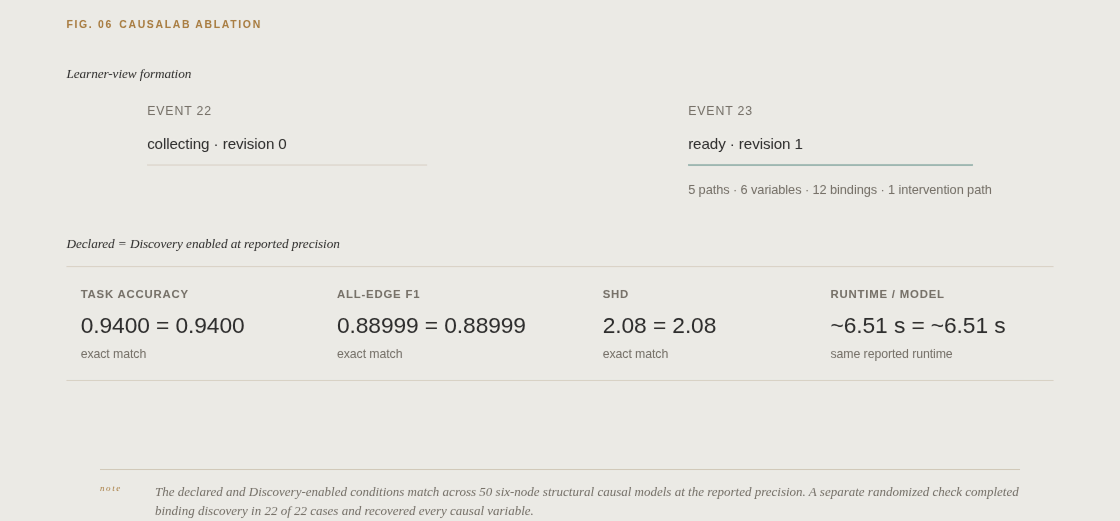
Across 50 fresh six-node structural causal models, both conditions reach 0.9400 task accuracy, 0.88999 all-edge F1, 2.08 structural Hamming distance, and approximately 6.51 seconds per model. Equality is reported at the displayed precision.
A separate randomized check completes binding discovery in 22 of 22 cases and recovers every causal variable. Across the 50-model benchmark, the Discovery-enabled condition produces 31 distinct input-path sets. The randomized check and the benchmark are separate evaluations.
This ablation isolates the removed declaration. Graph recovery and runtime remain unchanged at the reported precision after the causal learner view moves from pre-run configuration into revisioned state.
8. Next steps
Adapt-1 Preview removed task-specific pretraining and the separate training phase from the starting condition. Discovery (Beta) removes the authored learner ontology. Discovery already moves input paths, representations, field combinations, temporal lags, action and intervention roles, transition bindings, causal variables, and task hypotheses into the running instance.
The system still receives a simple task contract: the interaction surface, legal choices, learnable outcome, chronology, and episode boundary. Everything else shown in this article can begin unresolved and become persistent state during use.
The goal is to make test-time learning practical under real system constraints. Learning should begin from the interaction already required to perform the task, remain queryable throughout that process, and preserve the performance, latency, provenance, inspectability, and control expected from a prepared system.
Making Domains optional is next. A prompt should be enough to describe the interaction and begin. Adapt-1 will form the task contract and initial learner view from that description, then refine them from live evidence. Explicit Domains will remain available when a team wants to inspect, pin, reproduce, or govern the resulting specification.
Discovery already removes a large amount of integration work. Prompted setup removes the remaining authoring requirement. The direction is toward no task-specific pretraining, no authored learner ontology, and eventually no required Domain before online learning starts.
View the docs: https://docs.reilabs.org/docs/neuroadapt/discovery
View the guide: https://github.com/0xReisearch/adapt1-behavioral-study/tree/main/06-AUTONOMOUS-DOMAINS
Access the Preview: https://app.reilabs.org/adapt-1